The unfinished task is only half the problem
You already know what you should be doing.
You have read the books. Saved the routines. Watched disciplined men explain how they structure their days.
You have probably designed a few perfect schedules of your own.
Then life changed. Motivation disappeared. You missed one day, then another. The plan collapsed, and the familiar verdict returned:
Maybe I am the problem.
You do not need another person shouting at you to work harder.
You do not need more information. You need a way to keep moving when the excitement is gone—a method that can survive resistance, low energy, imperfect days, and the moment when your mind starts offering reasonable excuses.
Because every abandoned commitment costs more than the unfinished task. It teaches you that your own word cannot be trusted.
- You promise tomorrow will be different, but tomorrow keeps becoming another version of today.
- You consume more advice because learning feels safer than testing yourself again.
- You build plans for your strongest days, then judge your character when they collapse on ordinary ones.
- You miss once and treat the miss as permission to disappear.
- You see the man you could become, but every broken promise makes him feel less believable.
This cycle cannot be solved with a more impressive routine.
It changes when you make one reasonable promise, keep it, and allow the completed action to become evidence.
Then you do it again.
That is how your word begins to mean something.
Your self-trust is built from evidence.
There was a period of my life when my actions gave me every reason to distrust myself.
I spent years in addiction. At 23, I served six months in a psychiatric ward. I wanted to become a writer and thinker, but I continued relapsing, postponing meaningful work, and feeling like an impostor.
I was surrounded by ideas about psychology, philosophy, spirituality, and human change. I read, journaled, and imagined the person I wanted to become.
Insight alone did not close the gap.
My life began changing when meaningful actions stopped being ideas and became promises I could keep.
Reading. Writing. Journaling. Prayer. Exercise.
The actions began small. Five minutes was the starting load, not the size of my ambition. Their value came from repetition. Each completed action gave me another piece of evidence. Over time, that evidence changed what I believed I could expect from myself.
I am no longer living the life I once believed would define me. I write and create every day. I coach people, publish my ideas, and continue building a life around the mission that first appeared during my lowest years.
The process has never been a perfectly rising line.
After personal circumstances once pulled me away from my established habits, I did not attempt to rebuild everything in a single morning. I returned with two actions:
- Five minutes of reading.
- A five-minute creative brain dump.
Thirty days later, I had returned to the longer daily practice I had previously built over years.
That longer routine is not the standard you need to copy.
The useful proof is that returning began with ten honest minutes.
You do not wait until you feel disciplined enough to act. You choose an action small enough to perform honestly.
This is the principle behind The Inner Habits Method:
Action → Evidence → Identity
You choose a meaningful action small enough to survive a difficult day. You record what happened. You learn from the evidence. Then you increase, hold, or reduce the action according to reality.
The identity follows the proof.
“I have learned to slowly build habits that I can sustain throughout any day, no matter how I am feeling.”Anil · paying member
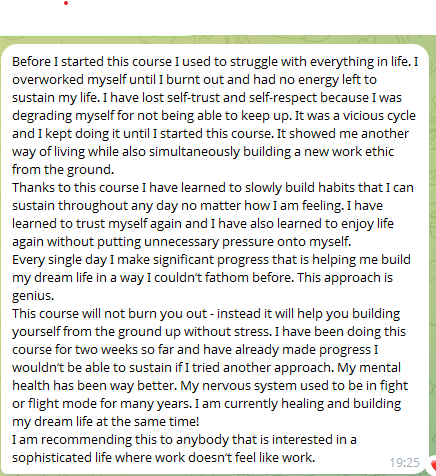
Anil described entering the course caught in overwork, burnout, low energy, and lost self-trust.
After beginning the process, he reported renewed self-trust, less unnecessary pressure, better mental well-being, and meaningful progress during his first weeks.
His experience captures the purpose of the method.
The goal is not to force yourself into a life that looks disciplined from the outside.
The goal is to build a practice you can sustain from the inside.
The method, the witness, and somewhere to return.
The Alchemy of Action is an $11-per-month Skool community for ambitious men who are tired of consuming advice, restarting plans, and slowly losing faith in their ability to follow through.
Your membership includes Inner Habits, a written, self-paced 30-day course designed to help you keep at least 21 of your first 30 daily promises.
The course gives you the method.
The community gives you witness, feedback, and somewhere to return when your private negotiation begins.
- The complete Inner Habits course. Eight concise written modules that turn one meaningful direction into a finished record of action.
- A weekly Inner Habits hot seat and Q&A. Bring the point where you are stuck and get help finding the next honest decision.
- Daily Evidence accountability. Post completed promises, difficult-day actions, misses, and returns before private resistance becomes disappearance.
- Community feedback. Ask for one clear decision when you cannot see the next step and learn how to respond usefully to other members.
- The Inner Habits workbook and Evidence Ledger. Design your promise, record what happened, write identity from evidence, and plan what comes next.
One course supplies the method. The community helps you keep using it.
Join The Alchemy of ActionYour first 30 days.
Choose the purpose your habit will serve.
Define what you are moving toward, why it matters, and which pattern you refuse to continue. You need one honest direction that makes today’s action meaningful.
Design your Minimum Honorable Action.
Turn your direction into one observable promise that can survive a difficult day. Five minutes is the default floor. Extra effort never becomes tomorrow’s debt.
Catch the drift before it takes the day.
Recognize the thought, feeling, or story that appears before you disappear. Use the Inner Pause to create enough room for the smallest honorable action.
Record proof instead of relying on memory.
Use the Evidence Ledger to record keeps, difficult-day keeps, misses, and returns. Replace vague self-judgment with a record of what actually happened.
Return without restarting.
A miss remains a miss. The Broken Streak Protocol helps you understand it, change one condition, and return without erasing the record.
Expand without breaking the habit.
Increase when your record supports an increase. Hold or reduce when reality requires it. Stop at a sustainable plateau instead of turning progress into another collapse.
Day 30: Complete your proof.
At the end of the course, you assemble your evidence into an Inner Habits Proof Pack.
You will name the purpose your habit served, the promise you practiced, how many of the 30 promises you kept, how you responded after resistance or a miss, what identity statement the record supports, and whether your next cycle should Continue, Hold, or Transfer.
Your target is at least 21 kept promises out of 30.
That number is not a guarantee that your identity will transform on command. It is a concrete standard that lets you finish the month with evidence rather than another vague impression of failure.
You can learn privately. You do not have to struggle privately.
A self-paced course can teach you the method. It cannot notice when you quietly stop opening it.
Inside The Alchemy of Action, your practice has somewhere to live. You can post the proof in Daily Evidence, ask for one decision in Get Unstuck, bring recurring resistance to the weekly hot seat, share the completed record at Day 30, and begin the next supported cycle.
No one needs to pretend the process is perfect.
A miss stays in the ledger. A return becomes new evidence. The community exists so that one difficult day does not silently become another abandoned month.